English shadowing practice is a input-led speaking method where you listen to a piece of English and try to imitate its pronunciation, rhythm, stress, and intonation.
It is different from free speaking practice. Free speaking starts with your own ideas: you try to say something, get feedback, and then improve or reuse the expression. In the previous article, I shared a step-by-step guide to practicing English speaking with ChatGPT in this way.
In this article, to see whether works well for English shadowing practice, I tested ChatGPT myself with different GPT mode and prompts.
My view is pretty clear: AI voice is not a good main audio source for shadowing, and it cannot replace real human speech. But AI can still support shadowing practice in useful ways. It can help you prepare materials, check difficulty, create practice sentences, and get quick feedback after practice.
What I Found When I Tested ChatGPT for Shadowing
I first asked ChatGPT to estimate my speaking level from a few short answers about my work and daily life, then asked it to create B1-level practice sentences based on a real work situation.
The sentences were useful as personalized practice material because they were close to things I might actually say. But the main limit didn’t come from the text.
It was the audio source and the practice format.
Read Aloud: Clear, But Too Stiff for Shadowing
Read Aloud can be useful as a basic reference, but I would not use it as my main shadowing audio.
If you only want to hear how a sentence sounds, it is fine. The pronunciation is clear. But if your goal is to train pronunciation through shadowing, it is not enough. The voice feels too stiff and too neutral.
Voice Mode: Better for Guided Practice
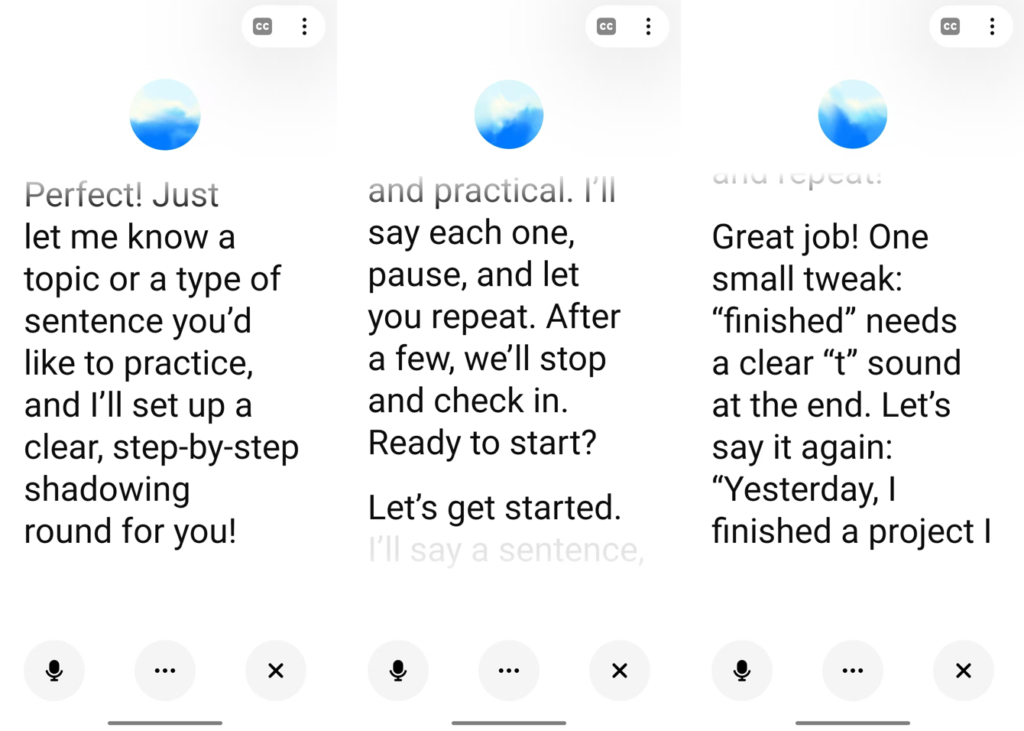
Compared with Read Aloud, I found Voice Mode more useful for guided speaking practice. It sounds closer to a real conversation.
I could ask it to read the whole paragraph first, then guide me sentence by sentence. If I did not hear something clearly, I could ask it to slow down. It could also give quick feedback based on what I said.
For example, during the test, it reminded me that:
- my past tense -ed ending sounds should be clearer
- some words were stretched too long
- “dig through” and “dig into” have different meanings and usage
But there is one thing to watch out for. I asked it to read the full paragraph first, and then guide me sentence by sentence. If I started with single-sentence repetition too early, the conversation drifted more easily.
Limitation: Voice Mode Is Not Real Shadowing
Voice Mode is useful, but it is not the same as real shadowing.
In real shadowing, you follow a piece of audio and imitate its sound, rhythm, and intonation almost at the same time.
In Voice Mode, once you start speaking, the AI usually stops and listens. So you are not following a continuous audio source. You are waiting for it to finish, then repeating after it.
That kind of practice is closer to guided repetition than strict shadowing.
Limitation: AI Does Not Fully Know the Speaking Context
Another problem is that stress and rhythm in real speech often depend on context. The same sentence can sound different depending on what the speaker wants to emphasize.
AI can give general feedback, but it cannot always understand the subtle tone of a real situation.
How AI Can Actually Help with English Shadowing Practice
So if AI should not be the main audio source, how can it still help with English shadowing practice?
I think these four uses are the most practical. I include prompt examples for each one, but you can also adjust them for your own practice goal. For that, you may find this guide on how to write tailor-made ChatGPT prompts for English speaking practice helpful.
Use AI to Estimate Your English Speaking Level
You can first ask AI to estimate your general speaking level. Then, when it recommends materials, generates sentences, or checks the difficulty of a transcript, it can stay closer to your actual ability.
Prompt:
Ask me 5 simple speaking questions to estimate my English speaking level.
After I answer, tell me whether I am closer to A2, B1, or B2.
Analyze the common mistakes in my oral English.
The point is not to get a perfectly accurate level. It is to give AI a basic sense of where you are now.
Turn What You Want to Say into Practice Speaking Materials
This is one of the most useful parts for me.
Traditional shadowing usually means imitating material that someone else has already spoken. That is useful, especially for training real pronunciation, rhythm, and intonation.
But sometimes, those materials are far away from what you actually need to say.
AI can work from the other direction. You can start with your own idea, ask AI to turn it into more natural spoken English, and then use those sentences for practice.
Prompt:
Here is what I want to say:
[write your idea in English or your native language]

Turn it into natural spoken English sentences for practice.
Keep the meaning close to mine.
Use clear rhythm and English that fits my speaking level.
This works especially well for personal speaking material: your work, daily life, study, or anything you actually want to talk about.
Use AI to Recommend or Check Real Audio Materials
You can also ask AI to recommend materials based on your level and goals. Or, if you have already found a video, you can send the title and transcript to AI and ask whether it is suitable for shadowing.
The point is not to let AI make a final decision for you. The point is to make it explain why: sentence length, vocabulary difficulty, speech style, and whether the material is good for repeated imitation.
Over time, those explanations can help you understand what kind of material fits you, instead of just picking a random English video and trying to shadow it.
Prompt:
I found this English video for shadowing practice.
Here is the title and transcript:
[paste title and transcript]

Please tell me whether it is suitable for a B1 learner.
Check sentence length, vocabulary difficulty, speech style, and whether it is good for shadowing.
Use ChatGPT Voice Mode for Quick Pronunciation Feedback
After practice, you can use Voice Mode to ask for quick feedback on the most obvious problems.
But I would treat this as quick correction, not as a replacement for a real teacher or a professional pronunciation tool. AI may not catch subtle intonation, emotion, or context-based stress accurately.
Final Thoughts: live inside the situations where language happens
AI can help with preparation, material selection, sentence practice, and quick feedback. But for shadowing, I would still keep real human audio at the center. AI can help with preparation, material selection, sentence practice, and quick feedback. But for shadowing, I would still keep real human audio at the center.
Language is not only pronunciation, vocabulary, and sentence structure. It also carries emotion, intention, relationships, and the context of the moment. AI can simulate expression, but it cannot fully carry those subtle human details.
I think that is the biggest limitation of AI in language learning right now: it can generate and correct language, but it does not really live inside the situations where language happens.