Many non-native English speakers want to practice speaking, but they do not have a steady English-speaking environment.
If you do not live in an English-speaking country, it can be hard to find someone to practice with regularly. And even if you do live abroad, you may still notice a gap between test-based English and real conversations. You understand a lot, but you react slowly. You know the words, but the sentence does not come out naturally.
Practicing with real people can feel awkward. Hiring a tutor for the long term can also be expensive.
ChatGPT can help. It gives you a low-pressure way to practice speaking on your own. The core daily-life speaking practice loop is:
Output -> Feedback -> Repeat -> ReuseWhich ChatGPT Mode Should You Use for Speaking Practice?
ChatGPT Voice Mode: best for real-time conversation
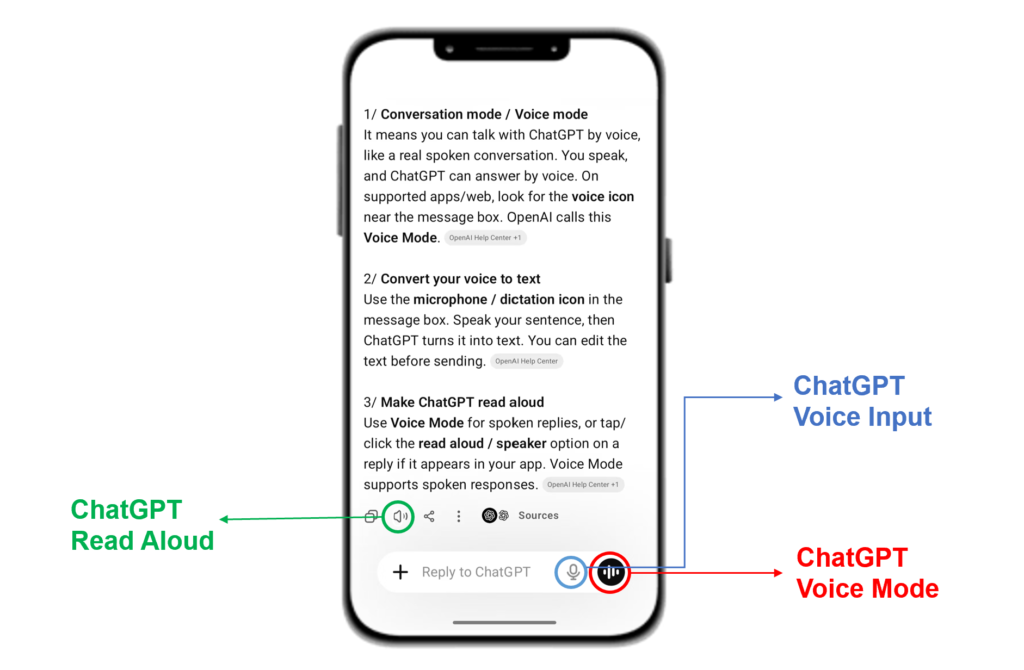
You can use ChatGPT Voice Mode either on the web or in the mobile app. You speak, ChatGPT answers, and you practice reacting in English in real time.
Some English learners feel that ChatGPT speaks too fast. I tried asking it to slow down, and surprisingly, it works.
Voice input + Read Aloud: better if you still need text support
If listening is still difficult, you do not have to force yourself to use Voice Mode right away. You can tap the microphone beside the message box and use voice-to-text input instead.
That way, you will see both your own message and ChatGPT’s reply as text before continuing the conversation. Then use the built-in Read Aloud feature to listen and repeat the GPT expressions.
How to Practice Speaking with ChatGPT Step by Step
Step 1: Set ChatGPT up as your speaking partner
Before you start talking, give ChatGPT a clear role to tell it how you want it to respond.
I In this kind of practice, you want ChatGPT to:
- act like a patient English-speaking partner
- correct the key mistakes without interrupting too much
- keep the conversation going with follow-up questions
I usually start with a prompt like this:
I want to practice spoken English through daily life topics. Please talk with me like a patient English-speaking partner.
When my English sounds unnatural or unclear, give me a more natural version and briefly explain the key expression. Don't correct every small mistake. Focus on the most useful corrections. Keep the conversation going with follow-up questions.
Step 2: Speak first, even before you know the perfect expression
A lot of English learners fall into the same trap: “I need to know the correct expression before I start speaking.”
But real conversations do not give you time to look up every word or translate every sentence. You have to respond with the English you already have.
So even if your English sounds messy, say it first. Try to get the meaning out with the expressions you already know. This part matters because speaking shows you where the gaps are. You start noticing which words you are missing, which sentences feel difficult to organize, and which expressions seem unnatural.
Here is a real example from my own practice.
One morning, I was baking scones. I wanted to talk about baking in English so I could share that kind of topic with others later. I did not search for “20 common baking expressions” first. But organize the words directly:
Hey, I baked scones this morning. It is the orange flavor I think. I adjust the recipe I search from the Internet. I added more water and reduced the usage of the butter. And I found the surface of this scone become more crispy and the filling is softer. What I've said is in the field of baking in English. Can you help me say this more naturally? Please correct the main mistakes and explain the useful expressions.There are many stiff or confusing parts, like “it is the orange flavor,” “reduced the usage of the butter,” and “surface of this scone.” But that’s okay.
ChatGPT helped me turn it into a more natural version:
Hey, I made some scones this morning. They were orange-flavored, I think. I followed a recipe I found online, but I tweaked it a bit. I added more liquid and used less butter. The outside turned out crispier, and the inside was softer. Could you help me make this sound more natural, especially the baking-related words?Step 3: Repeat the natural version ChatGPT gives you
This is the part most English learners skip.
After ChatGPT gives you a better version, do not just read it and think, “Okay, I get it.” Repeat it out loud.
This is a little like English shadowing practice, but less mechanical. You are not trying to memorize every word. You are using ChatGPT’s version to express the same idea more naturally in your own way.
Then ask ChatGPT to check your repetition. If something still sounds unnatural, repeat it again and adjust it. Keep going until you can say the whole thing smoothly.
Try this prompt:
I'll repeat your version. Please check if I say it naturally and keep the same meaning.
(your repetition)
(ChatGPT corrects you)
(repeat again)
Step 4: Keep talking and use the new expressions again
Do not stop after one sentence.
ChatGPT is useful because it can keep the topic going with follow-up questions. For example, after the scone conversation, it might ask:
How did the scones taste?Then you keep answering in English. Try to reuse the expressions you just learned. If a new word or expression comes up, you can guess first:
Maybe because I added less oil and sugar (reuse). The taste of this scone is a little bit light. You know light? It is 淡 in Chinese. Is it the right word here?(guess)A daily-life topic is not one sentence. It is a chain of related questions. That is how you slowly build a set of expressions around one real-life topic.
Step 5: Make a short review note after the practice
Do not close the conversation as soon as the practice ends.
Ask ChatGPT to make a short note with the useful expressions you learned. You can paste it into your own English notes by topic and review it later.
Try this prompt:
Can you help me summarize what I practiced today?
Please give me the useful expressions, the mistakes I made, and better versions.
Keep it short and easy to review.
What Can You Talk About with ChatGPT Every Day?
Choose one small daily-life topic each day. Do not make it too big.
For example:
- what you ate today;
- a video you watched recently;
- a small problem from work or study.
If you do not know what to talk about, this prompt can help:
Please give me five simple daily-life topics for spoken English practice today. Choose topics that are easy to talk about but useful for real conversations. For each topic, give me one opening question.English Speaking Prompts Summary: Copy and Use
You do not need to use all of these prompts every time. Choose the one that matches your practice goal for the day.
Set ChatGPT as your speaking partner
I want to practice spoken English through daily life topics. Please talk with me like a patient English-speaking partner.
When my English sounds unnatural or unclear, give me a more natural version and briefly explain the key expression. Don’t correct every small mistake. Focus on the most useful corrections. Keep the conversation going with follow-up questions.
Make my spoken English sound more natural
Can you help me say this in a more natural way? Just correct the main mistakes and tell me the useful expressions.
Explain a word or expression I do not understand
Can you explain this word in simple English and give me one example? If it’s still hard to understand, please explain it in my native language.
Check your repetition
I’ll repeat your version. Please check if I say it naturally and keep the same meaning.
Summarize the practice
Can you help me summarize what I practiced today?
Please give me the useful expressions, the mistakes I made, and better versions.
Keep it short and easy to review.
If these prompts do not fit your needs, you can also learn how to write prompts for your own English speaking goals.
Repeat Until You Can Express
Using ChatGPT for speaking practice is not about asking it to generate a pile of perfect answers. If you only copy its sentences, it won’t help much.
What helps is the loop: say your own version first, let ChatGPT give you a more natural version, repeat it, and then bring that expression back into the conversation.
Output -> Feedback -> Repeat -> ReuseAfter repeat this loop many times, you slowly build daily-life expressions that feel like your own. The next time you run into a similar situation, you are less likely to freeze. You are better at expressing what you actually want to say.
And that is the real goal of speaking practice.